
Niche 2026 Junior Survey: How Affordability and AI Are Reshaping College Search

Jump to a section:
- Executive Summary
- Part 1: Inside the Stop-and-Start Search
- Part 2: The Affordability Wall
- Part 3: Where AI Surges and Stalls
- Part 4: Recommendations and Playbook
Executive Summary
Cost is the biggest fear driving the class of 2027’s college search, ahead of admissions and fit. Nearly two-thirds have paused their search at least once, mostly because of overwhelm or sticker shock. And AI use has surged, even as students say they don’t fully trust what it tells them. These are among the top findings from the 2026 Niche Junior Survey of more than 2,100 high school juniors.
Three signals stand out:
- Affordability has overtaken admission and fit as the dominant anxiety. Nearly one-third of respondents cited affording college as their single biggest fear, and more than four out of ten don’t know how to evaluate what a reasonable cost would be.
- AI is now a mainstream research tool, with use increasing 23% to 37% year over year—but students verify what they find before acting on it.
- The college search has become exhausting, with 61% pausing at some point, largely due to overwhelm or cost—even among a group of students who overwhelmingly plan to attend four-year colleges.
For higher education enrollment and admissions leaders, the survey results have practical implications. The students most likely to engage with you are also most likely to pause their engagement. They’re prioritizing majors in their search, and rankings and reviews still inform their choices. They want help calculating cost, not just paying it. They are testing your information against AI, not replacing it with AI. And their parents are increasingly co-pilots—so your communications strategy needs to consider both audiences.
Part 1: Inside the Stop-and-Start Search
Most juniors we surveyed are mid-search and casting wide nets—but the journey is increasingly punctuated by pauses, and the supports that traditionally guided students are weakening while parents are taking on increasingly prominent roles.
Open to influence
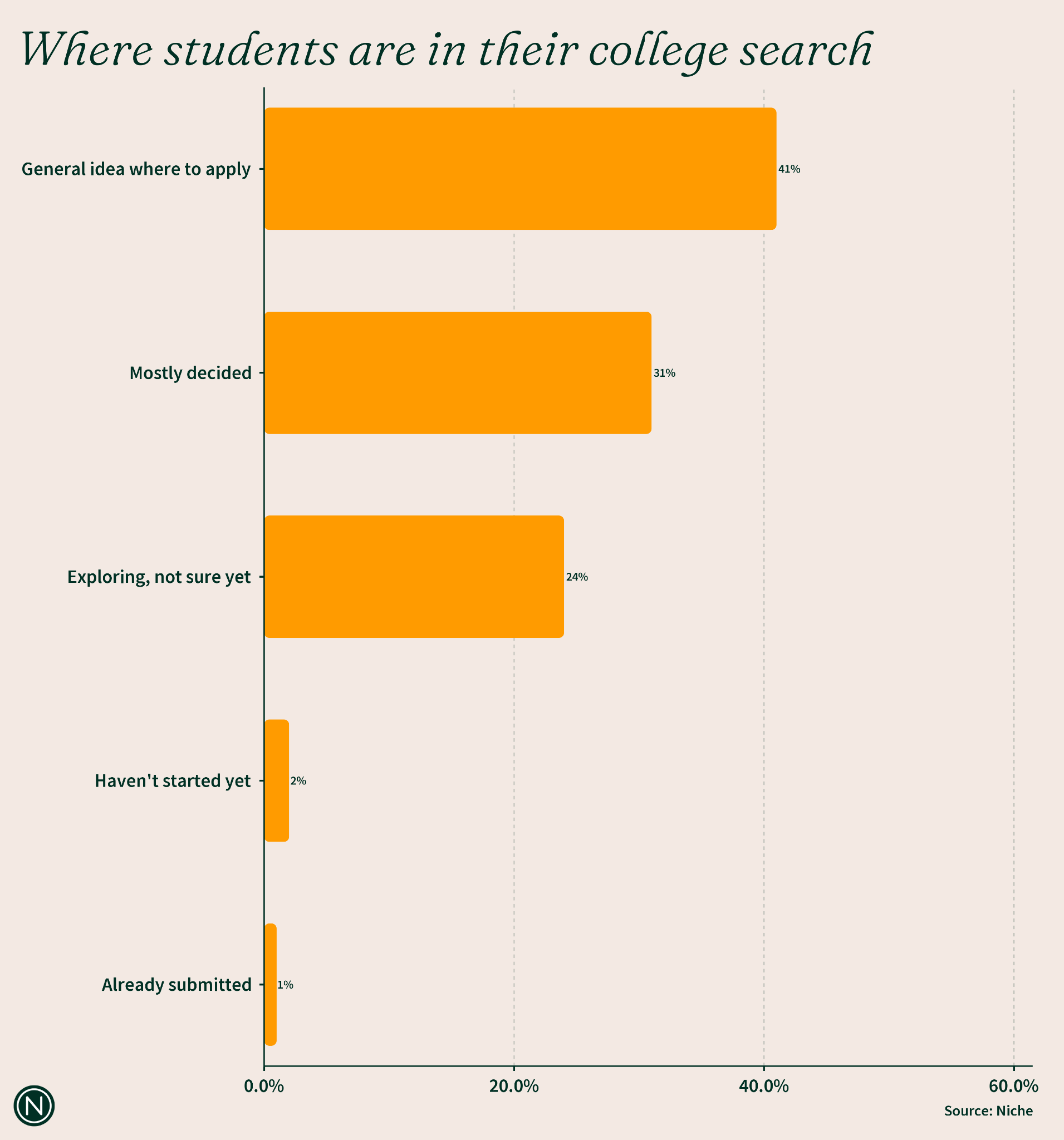
Nearly two-thirds (65%) describe themselves as either exploring or having a general idea of where they want to go, while 31% are mostly decided. Discovery and list-building tools matter more than late-stage decision aids for this group.
Punctuated searches
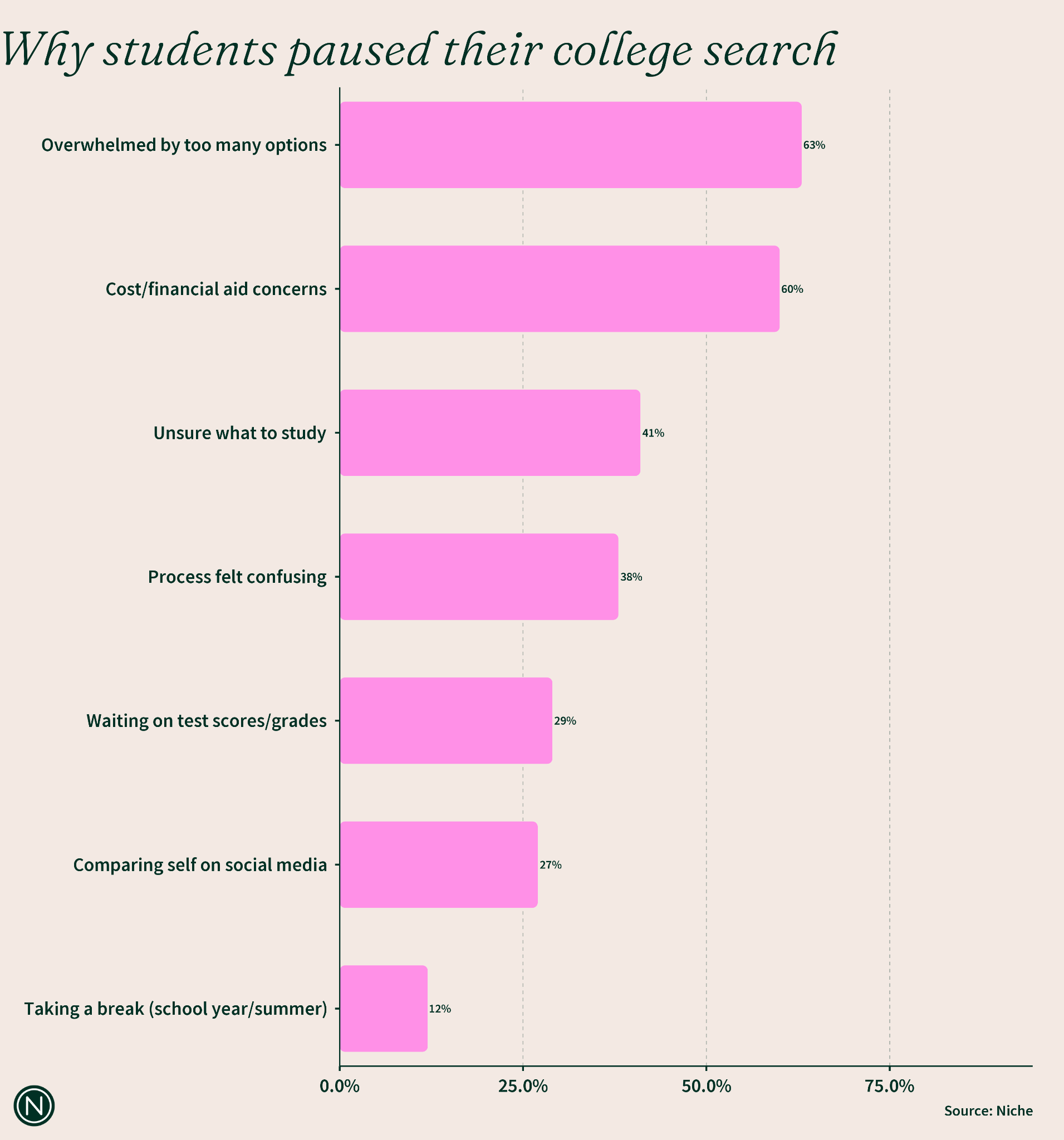
A whopping 61% of students report having paused their college search at some point—a remarkable share given that 93% of respondents plan to attend college right after high school. Two reasons dominate: 63% cite being overwhelmed by options, and 60% point to concerns about cost. Uncertainty about what to study follows, a finding that underscores the importance of majors and programs in the college search (more on that below). A non-trivial 38% pause because the process feels confusing.
Among students who pause, the gender split is stark. 64% of female respondents report having paused vs. 49% of male respondents.
The implication: re-engagement programming should be sized for the female majority of pausers. And the data on re-engagement is clear: family is the dominant lever. Four out of ten paused students cite parents or family conversations as what pulled them back, well ahead of every other channel. Counselors/teachers and college emails tie for second at 23% each. Campus visits (22%) and financial aid news (20%) reactivate similar shares. Search platform notifications come in at 14%—a meaningful share with room to make these more effective re-engagement signals.
Key takeaway: Parent-facing communications deserve dedicated budget and channels this cycle.
Admissions-option awareness
Among the admissions options, early decision is best known, with 84% of respondents having at least some familiarity. Early action follows at 73%.
Restrictive early action is the least known option, with more than half—56%—responding that they were “not at all familiar” with it. Direct Admissions is fast becoming a recognizable option, with just 31% saying they were “not at all familiar” with it.
Still, this year’s juniors know less about their admissions options than last year’s juniors, with familiarity down for early decision, early action, and Direct Admissions. Schools can reduce confusion by publishing and distributing accurate information early in the search process.
Research process
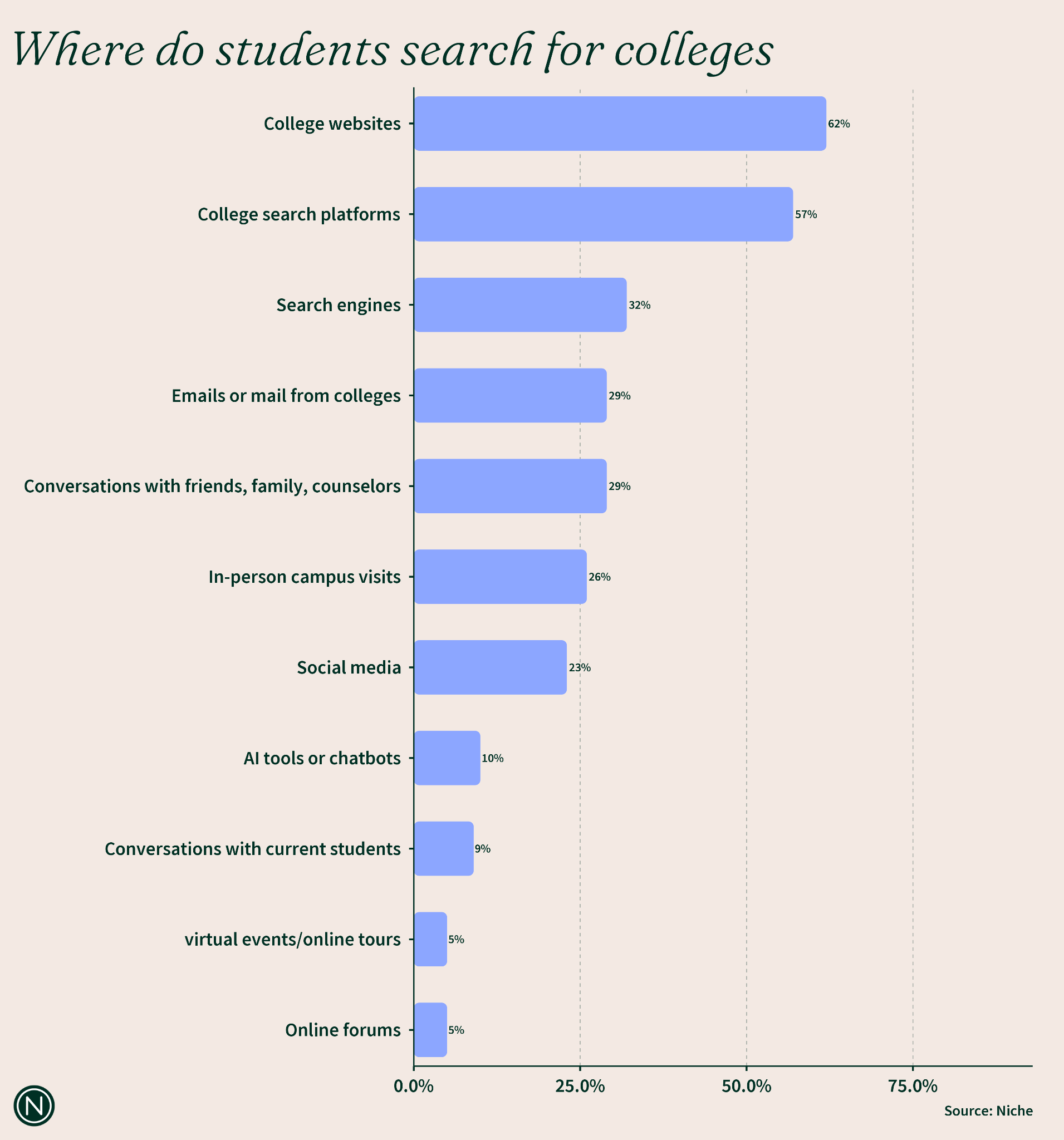
Students cast a remarkably wide net when conducting college research. Seven channels are used by 20% or more of students, led by college websites (62%) and search platforms like Niche (57%). Non-AI search tools remain the primary research channel for college search, even as AI tool adoption has surged (covered in part 3).
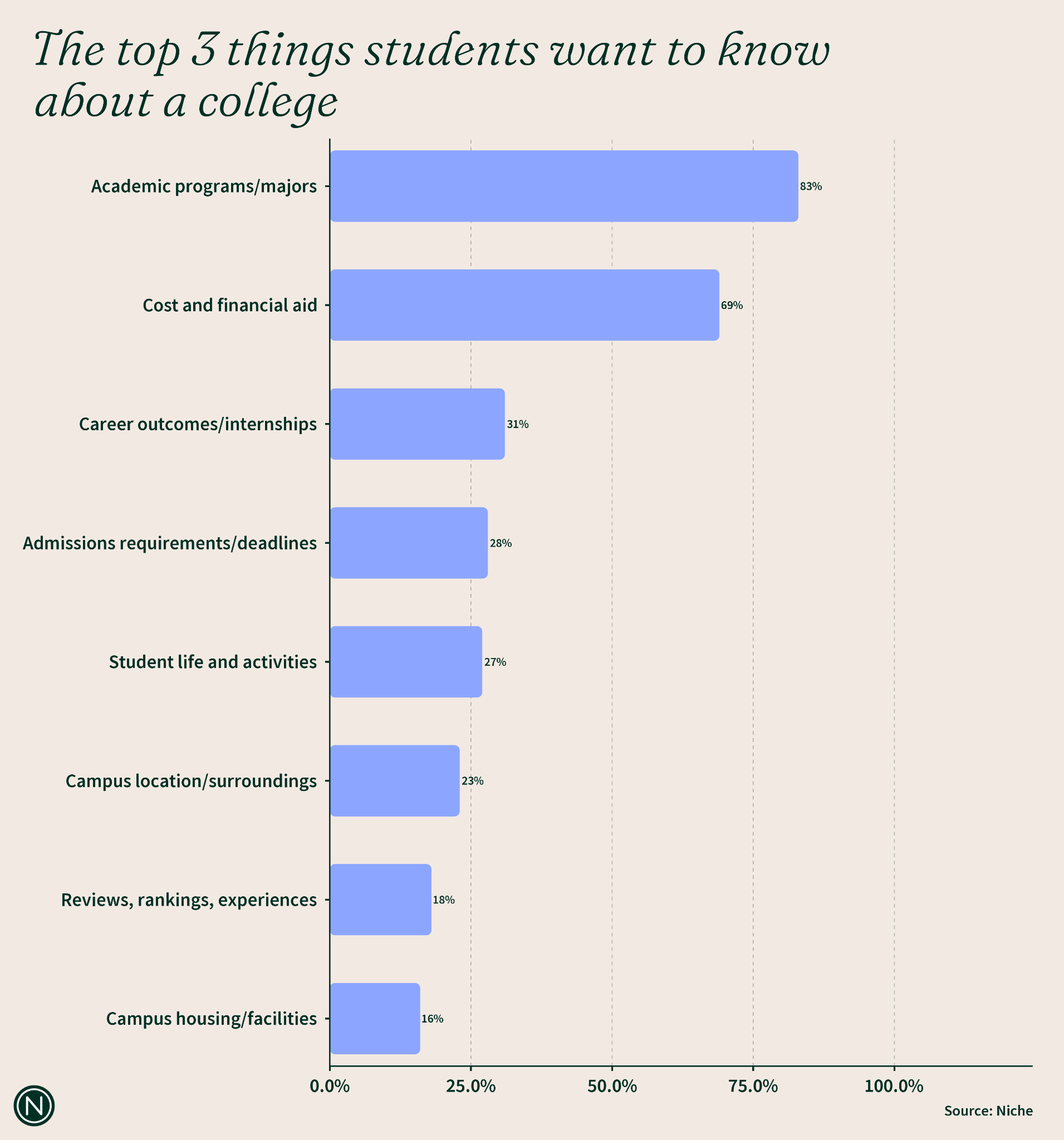
When students land on a college’s profile page, the click pattern is consistent and program-led. A significant proportion (43%) starts with majors and programs, by far the most-clicked first stop—a trend that reinforces the major-fit-as-filter finding that recurs throughout the survey. Admissions stats (19%) and cost information (18%) come next. Reviews and rankings capture 12% of first clicks. Virtual tours have ranked low as a priority twice in this survey.
Key takeaway: Program-led page architecture and major-fit messaging is likely to outperform prestige-led positioning for this cohort.
Politics and culture
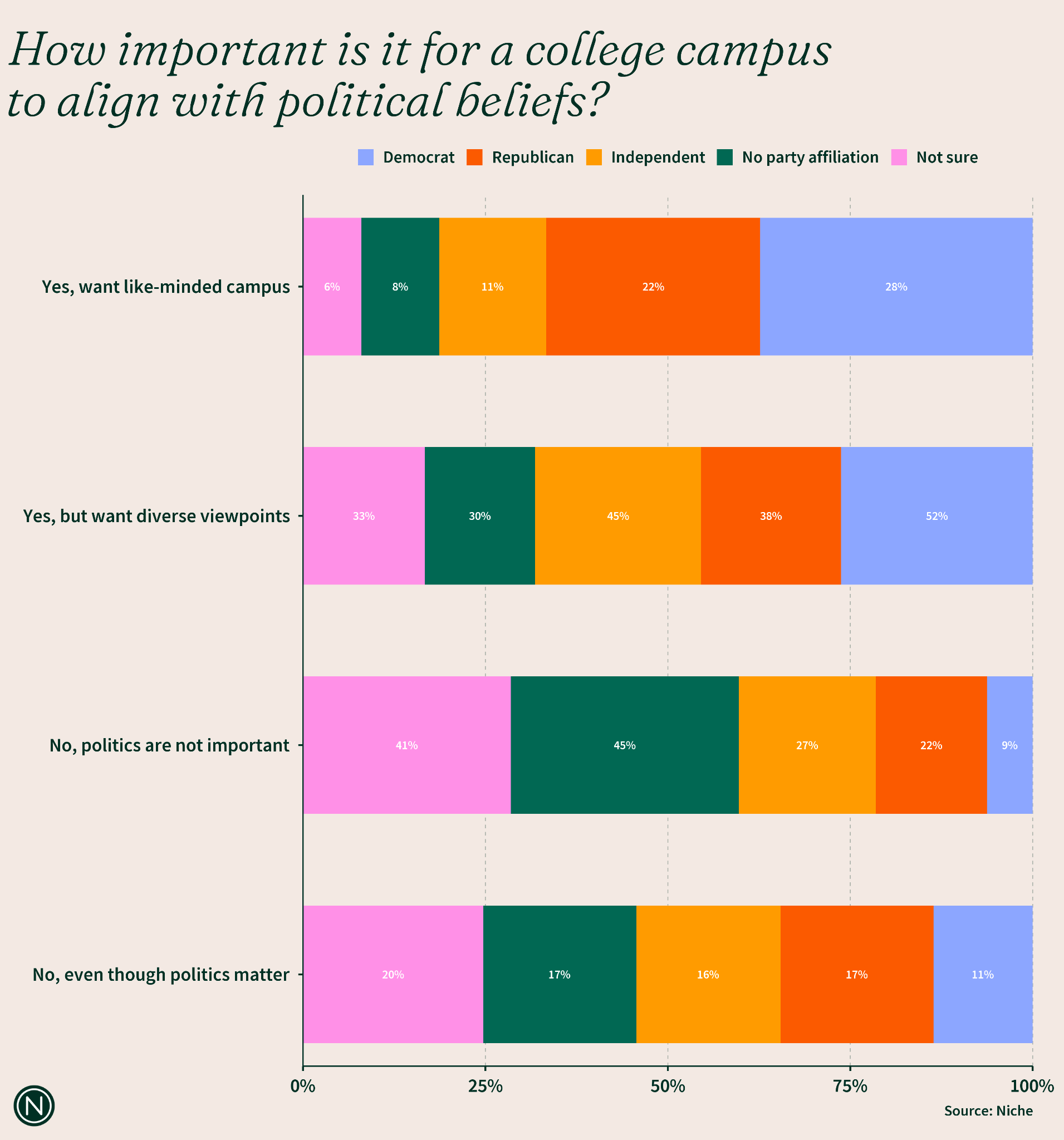
Politics play a role in the college search for a meaningful minority of students, particularly around state and regional choices. Wanting an ideologically aligned campus is not a partisan position, with 28% of self-identified Democrats saying they want a “mostly like-minded campus”—a bit higher than the 22% of self-identified Republicans who want the same. The most common response across all political affiliations is that diverse viewpoints are preferred.
Brand and rankings
A persistent narrative in higher education marketing is that prestige drives student choice. The data here suggests otherwise. Rankings and reviews rank as a top-3 information priority for only 18% of students—informative, but not foundational. Asked directly about brand and name recognition, most students place it as one factor among several.
Counselor and parent support
Counselor support emerged as a negative data trend, with excellent ratings falling from 19% to 17% year over year. The share of students rating their support as fair, worse, or nonexistent grew from 53% to 56%. Less than half of students (44%) rate their counselor support as good or excellent.
With an overall average student-to-counselor ratio of 372:1, counselors are stretched thin. The survey responses reflect this reality; the most common challenges students cite are limited counselor availability and difficulty getting personalized guidance.
With counselor support weakening, parent involvement is filling the gap. “Very involved” parents rose year over year, from 35% to 42%. “Won’t be involved” and “not yet involved” both shrank. Combined with the re-engagement finding cited above (parents are the #1 reactivation channel at 40%), this points to parents as the most influential figures in this year’s cycle—a finding with direct implications for your communications strategy.
Part 2: The Affordability Wall
Affordability is the dominant theme of the 2026 survey. It stands out as the principal source of anxiety and concern among members of the class of 2027.
Cost as the #1 fear and concern
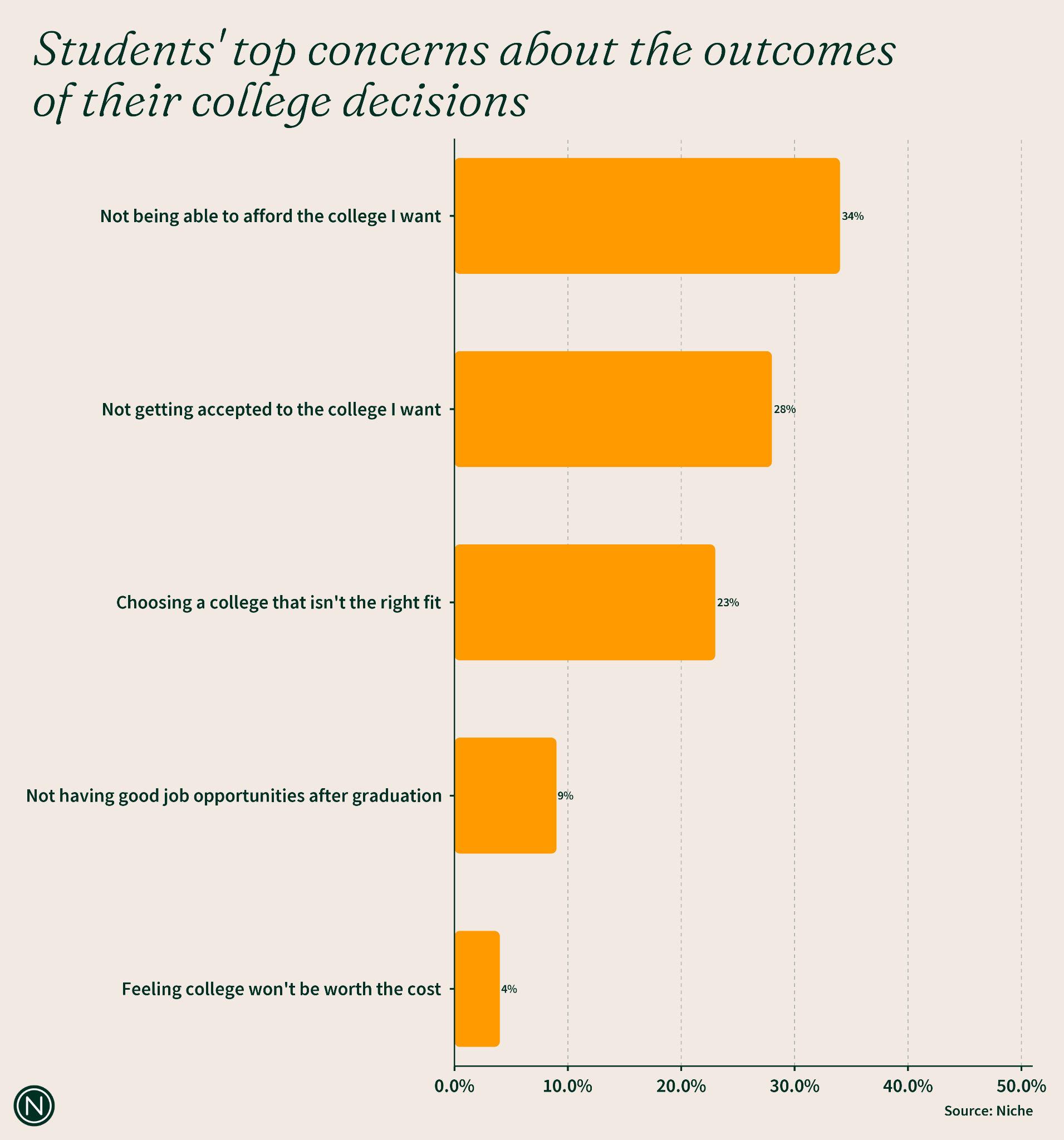
When asked their greatest concerns about their college decision outcomes, more than one-third of students named “not being able to afford the college I want”—ahead of admissions (28%) and fit (23%).
The greatest challenges
Even within the application process, scholarships top the “hardest” list, with 42% citing scholarships as among the most challenging aspects of applying to college—ahead of completing applications. Scholarships figure prominently in students’ plans to pay for college, with more than 95% citing them as an option they’ve considered to cover the cost.
Figuring out how much college will cost was cited as a challenge by 38% of respondents. Financial aid logistics are themselves an anxiety, according to 29% of respondents. In contrast, test score decisions are the lowest worry, clocking in at just 7%.
Key takeaway: Clear cost information is valuable early in the process.
Affordability by income
While cost anxiety is nearly universal, it isn’t evenly distributed. 43% of students from households earning under $60K name affording college as their #1 outcome worry, versus 25% of students from $200K+ households. For higher-income students, the top concern inverts toward fit, with 31% of $200K+ students saying that choosing the right college is their #1 worry—more than the share worried about cost.
The impact of income extends beyond cost. Four resources rise sharply with household income:
- Parent funding as a planned source: 35% for <$60K → 88% for $200K+ (+52 points)
- Parent involvement in the search: 28% → 57% (+28 points)
- Campus visits made: 60% → 85% (+25 points)
- AI tool adoption: 30% → 52% (+21 points)
Fewer low-income students have a parent guiding them, fewer have visited a campus, fewer use AI to compare options. Free, trustworthy information matters most where private resources are thinnest.
Key takeaway: Cost-anxious and choice-anxious students are essentially shopping different products. Segmented messaging is critical.
Part 3: Where AI Surges and Stalls
AI use in the college search jumped from 23% to 37% in a single year—the biggest single shift in any comparable item in the 2026 survey.
What students use AI for
The dominant use cases are research-oriented, with students who use AI focusing on finding matching colleges, comparing colleges, exploring majors, and understanding financial aid. Despite fears that AI is creeping into college essay writing, only about one in ten students who use AI say they deploy it for that purpose (about 3% of respondents).
“Trust but verify” would make a good AI motto for students. Respondents report verifying what AI tells them before acting on it. The implication: trust signals, source links, and verified information matter more than ever.
Key takeaway: Ensure your site has source-linked, citation-ready content so that students can readily verify AI results.
The AI-defensive major
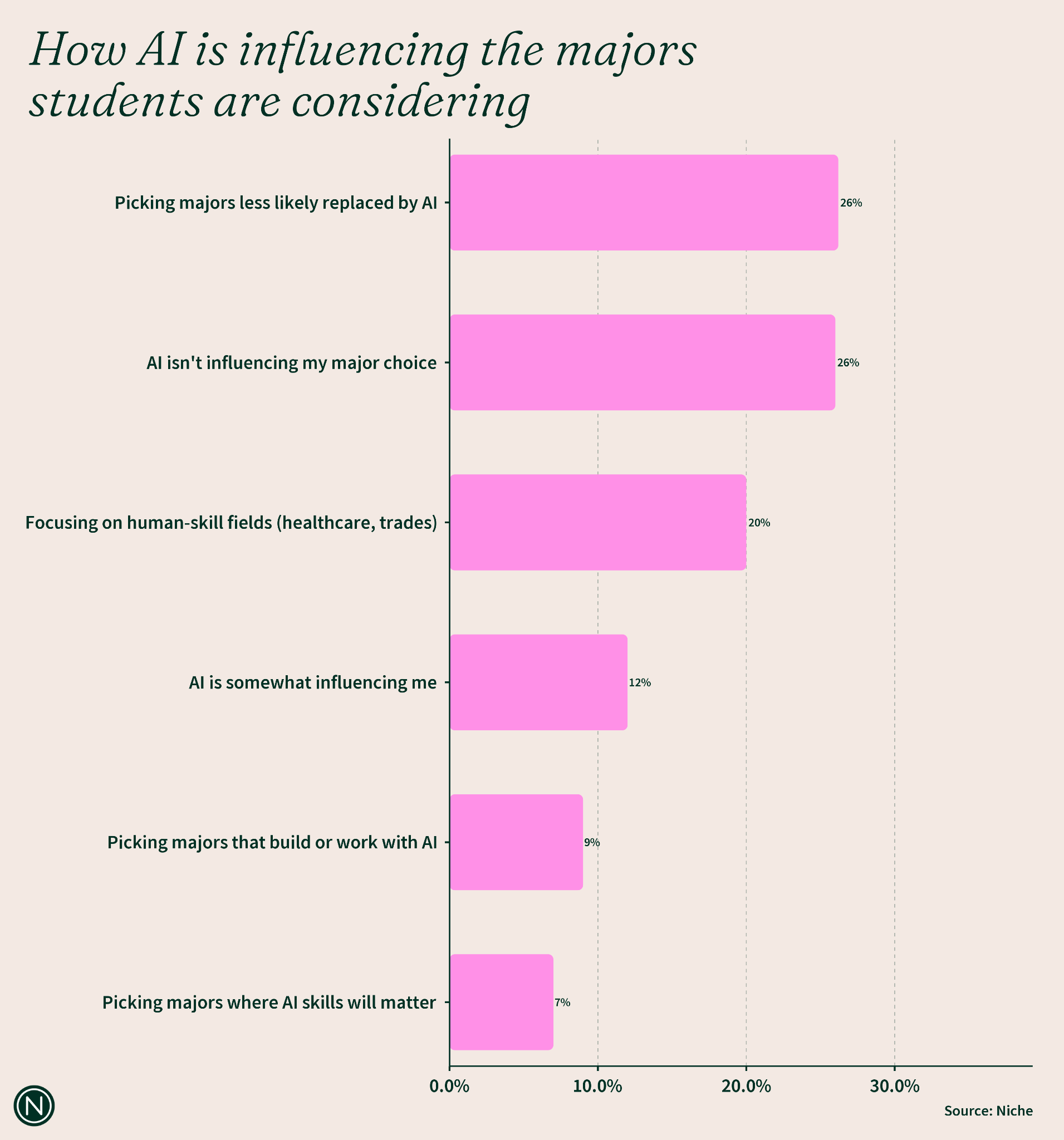
Students are choosing majors in ways that appear defensive against AI rather than aligned with it. For starters, the proportion of students who cited major fit as a dealbreaker was up across the board, with one-third saying they’d only consider colleges offering their exact major, and 60% deeming it important while saying they’d consider a college with similar majors.
The distribution of college majors shows a pull toward nursing, healthcare, education, and skilled trades, with software and computer science interest down. Students choosing AI-defensive majors outnumber those choosing AI-embracing majors by roughly 3:1. Niche platform data corroborates the trends that class of 2027 respondents reported.
Part 4: Recommendations and Playbook
Based on our survey findings, we have created strategic and tactical recommendations for higher education enrollment and admissions leaders.
Strategic priorities
Five themes stand out:
- Make cost calculable, not just affordable. Cost is the dominant anxiety, and a key underlying challenge is that students can’t price college.
- Talk to parents as a real audience. Parent involvement is rising, and parents are the top reactivation channel. Dedicated parent content deserves a budget line item.
- Become the source that AI fact-checks against. Students’ trust in AI is conditional. Source-linked, citation-ready content positions your site as an authoritative reference.
- Reduce search friction. Search fatigue is a real conversion risk. Providing program-led navigation, for instance, can reduce overwhelm—and help students build momentum in their search.
- Fill the counselor gap with self-serve resources. Institutions that offer resources absorb demand that high schools aren’t meeting.
Tactical recommendations by function
Each recommendation ladders up to a strategic priority.
- Financial aid: Surface net-price calculators earlier in the search. Build scholarship application help content. Publish printable cost worksheets that students can use with parents.
- Communications: Create a dedicated email track for parents. Produce “what to ask” guides. Host parent-specific webinars on cost and value.
- Content and SEO: Use structured data and clear citation patterns so AI tools quote your institution. Create and publish a calendar of authoritative verified content. Provide depth in program/major content.
- Recruitment marketing: Lead with major and program pages. Place a net-price calculator one click from every program page. Add citation-ready stat blocks for AI consumption. Deploy parent-facing content. Test re-engagement campaigns for paused searchers.
- Counselor outreach: Launch toolkits including FAQ libraries, application timeline templates, and scholarship guides that counselors can use and share. In parallel, create self-serve substitutes for families.
Final Thoughts
Tie at least one KPI to each strategic priority. (For example, set goals for parent email open and click-through rates.) Track your progress. Be proactive about appearing where students are searching, providing authoritative information, and anticipating their emerging needs with programs that address their fears as well as their goals.
The good news is that students are clearly asking for career-oriented programs and majors (particularly AI-defensive ones), financial aid transparency, and reliable college-search sources. The challenge—and opportunity—for higher education institutions is to meet the moment with answers to those questions.
Drive momentum and crush your enrollment goals
Advance delivers personalized, AI-powered messaging and next step nudges for students at every stage of the enrollment cycle — reaching them where they already are and driving real action.